
Did Simon Sinek Draw the Circle Wrong?

Few leadership ideas in the past two decades have been as widely shared as the Golden Circle introduced by Simon Sinek. Leaders across industries regularly quote the same powerful idea: people don’t buy what you do; they buy why you do it. The concept resonates because it speaks to something fundamental about human motivation. People are drawn to meaning, purpose, and belief. When organizations clearly communicate why they exist, they inspire trust, loyalty, and engagement.
However, after years of coaching leaders on strategy and organizational alignment, I often find myself saying: “I think Simon Sinek drew the circle wrong.” Not that the idea is wrong—but perhaps the way we visualize it is.
The Golden Circle
In Start With Why, Sinek introduced the Golden Circle to explain why some organizations inspire while others simply transact. The model is elegantly simple:
At the center is Why — the purpose or belief that motivates the organization
Surrounding it is How — the processes or approaches that differentiate it
The outer ring is What — the products or services the organization delivers
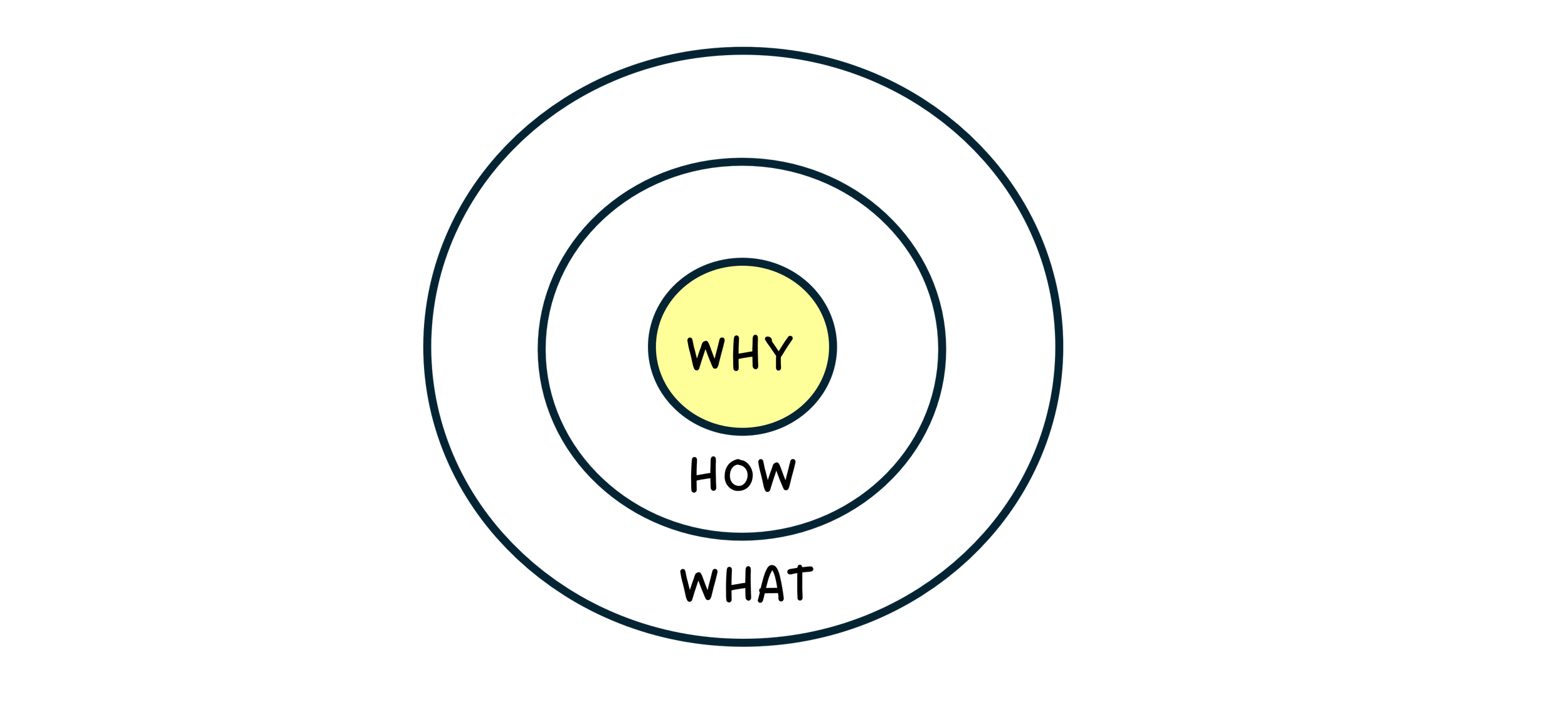
Sinek’s insight was that inspiring leaders communicate from the inside out. They start with purpose, then explain how they bring it to life, and finally describe what they produce. This order matters because people connect emotionally with purpose before they evaluate products or services. Organizations like Apple, Patagonia, and Southwest Airlines succeed not just because of what they sell, but because customers believe in why they exist.
A Different Perspective
While the Golden Circle works exceptionally well as a model for communication and inspiration, it becomes less clear when we examine how organizations operate internally. The diagram places purpose at the center, as if it pushes activity outward. But in reality, purpose often functions less like a central engine—and more like a boundary. Consider an alternative:
Purpose forms the outer circle
Strategy sits within that boundary
Execution sits at the core
This small shift reveals something important about how organizations actually function.
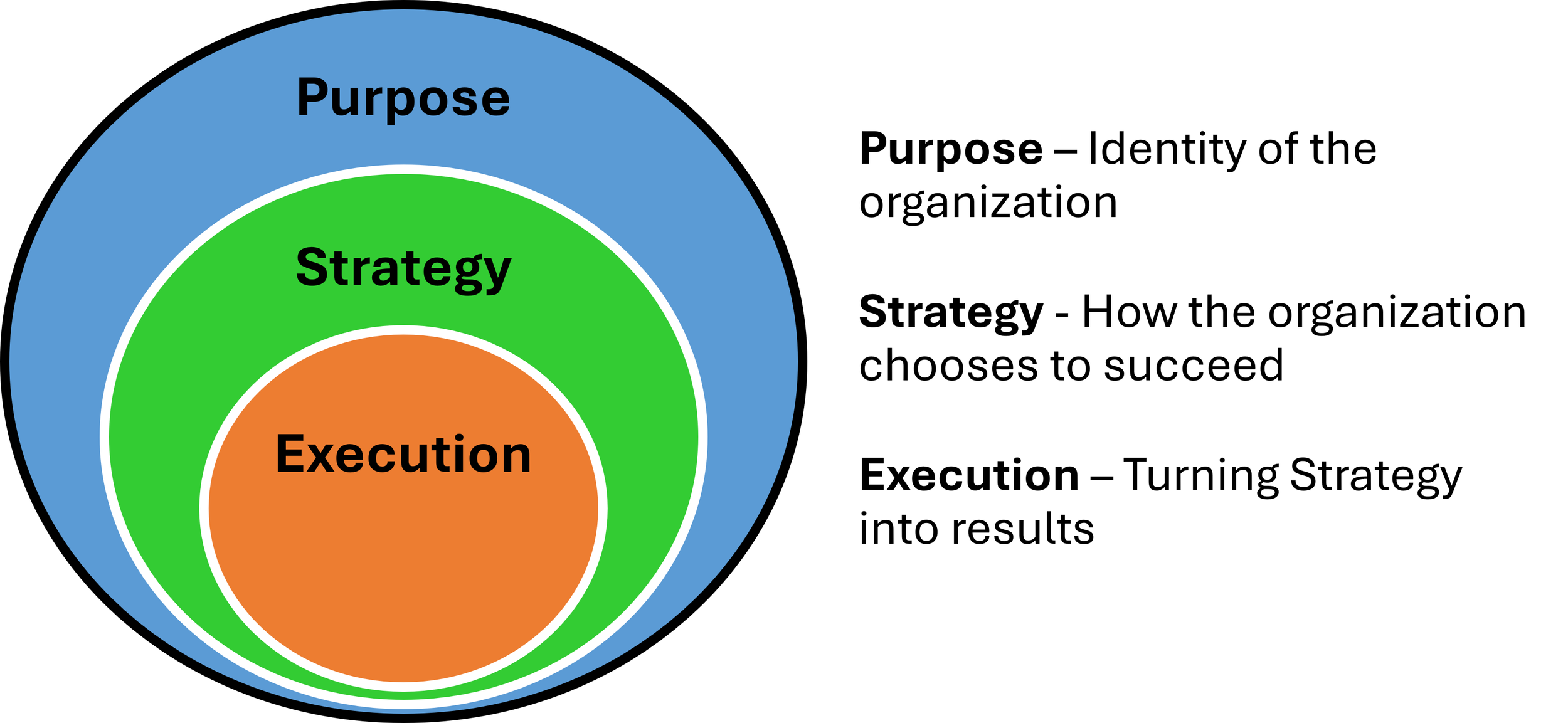
Purpose (“Why”) as the Boundary
When we think of purpose as the outer circle, its role becomes clearer. Purpose is not just an inspirational statement. It is the container that defines the organization’s identity; in essence, it is the “why” of the organization. It sets the boundaries for what the organization stands for—and what it will not do. When the purpose is clear, strategy becomes easier to define. Leaders can test decisions against a simple question: “Is this within the purpose of our organization?” If not, the strategy may deliver short-term gains—but it will eventually create confusion, disengagement, or distrust.
Consider a company that claims environmental stewardship as its purpose but pursues strategies that prioritize short-term profit at the expense of sustainability. Customers notice. Employees notice. Over time, credibility erodes. Purpose, therefore, is not a slogan—it is a constraint.
Strategy Within Purpose
Once purpose defines the boundary, strategy becomes the mechanism for making deliberate choices within it. Strategy answers fundamental questions:
Where will we compete?
Who will we serve?
How will we win?
Effective strategy requires focus—and discipline. It involves choosing what not to do as much as what to do. Organizations that chase every opportunity dilute their efforts and lose differentiation. Strategy is the bridge between belief and action. It translates purpose into direction.
Execution at the Core
At the center of the organization sits execution—the operational reality where strategy becomes tangible through daily work, decisions, processes, and systems. This is where intentions are translated into outcomes and where results are ultimately produced or lost.
Effective execution depends on the alignment of several critical elements. Capabilities include the skills, expertise, and resources required to deliver on strategic priorities. Operating systems provide the processes and workflows that enable work to be performed consistently and efficiently. Management systems establish the metrics, feedback loops, and governance structures that guide performance and ensure accountability. When these elements are aligned, execution becomes a reliable engine for delivering results; when they are not, even the best strategies struggle to gain traction.
Alignment and Misalignment
When purpose, strategy, and execution align, organizations experience clarity and coherence. Employees understand how their work contributes to something meaningful. Leaders make consistent decisions. Resources flow toward activities that reinforce the organization’s direction.
Misalignment occurs when one of these circles drifts outside the others. Strategy may drift away from purpose when organizations pursue opportunities that conflict with their identity. Execution may drift away from strategy when internal incentives reward the wrong behaviours. Teams remain busy, but progress becomes scattered and inconsistent.
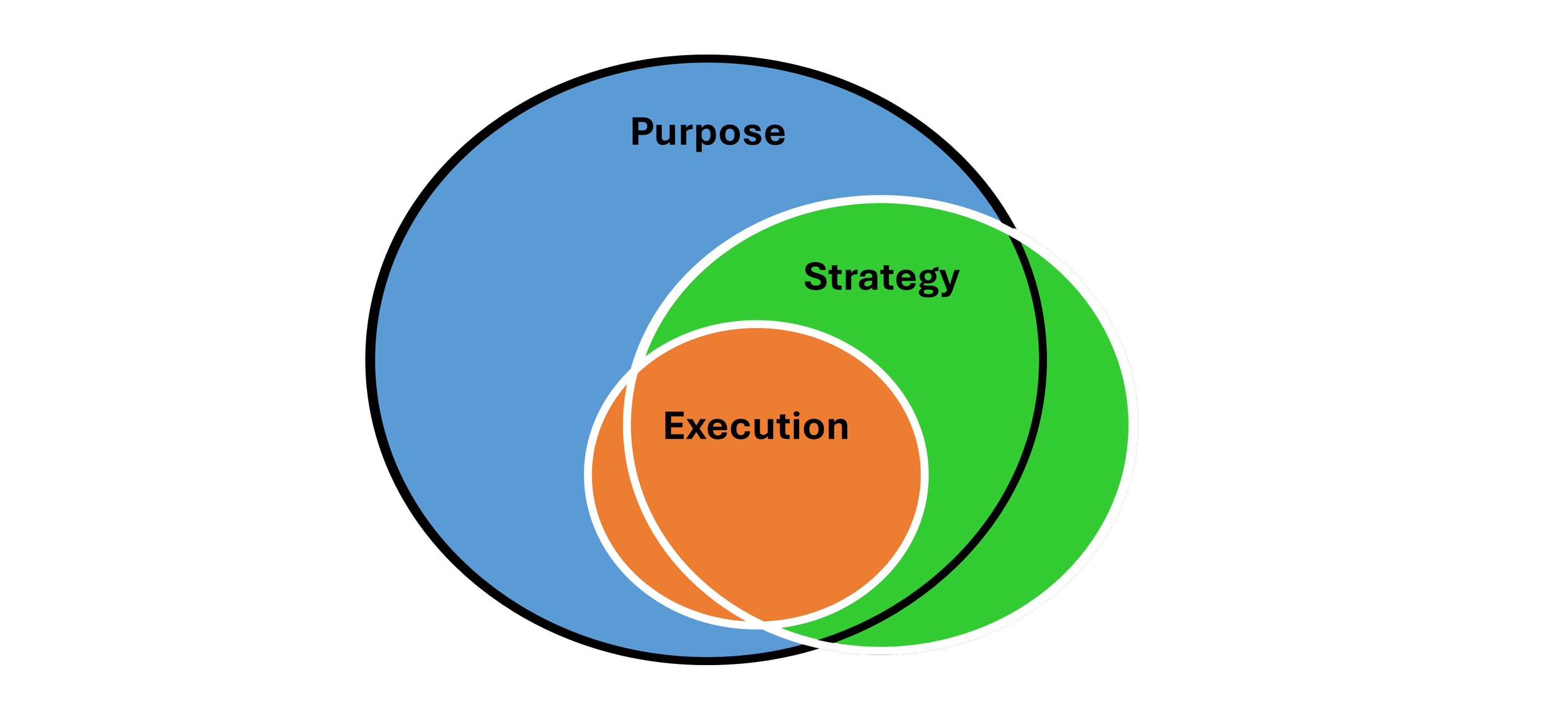
This kind of misalignment is surprisingly common. Organizations rarely fail because people are inactive. More often, they fail because people are working very hard on the wrong things. Projects multiply, meetings increase, and performance metrics may even improve—but the organization slowly moves away from its intended direction.
The Leader’s Role
Maintaining alignment between purpose, strategy, and execution is one of the most important responsibilities of leadership. Leaders must continually reinforce the organization’s purpose so that it remains visible in decisions and behaviours. They must make deliberate strategic choices that reflect that purpose. And they must design systems that translate strategy into consistent execution.
Leadership also plays a critical role in sustaining the human elements that enable alignment. Culture, communication, and employee engagement act as the forces that connect the circles. Leaders shape culture through behaviour and expectations. Communication ensures employees understand priorities and direction. Engagement sustains the energy required to execute strategy effectively.
So… Did Simon Sinek Draw the Circle Wrong?
Not exactly. The Golden Circle remains one of the most powerful models for understanding how leaders communicate inspiration, and the principle of starting with why continues to be essential for building trust, loyalty, and emotional connection.
However, when we shift from communication to organizational operation, a different perspective can provide greater clarity. Viewing purpose as the outer boundary that defines the organization’s identity, with strategy operating within that boundary and execution at the core, offers a more practical way to understand how organizations function day to day.
This perspective reinforces the importance of alignment: purpose guides strategic choices, and strategy drives execution. Ultimately, it is not a matter of one model being right or wrong, but of applying the right lens to the right context—using the Golden Circle to inspire, and the Alignment Framework to operate.
Ron Bettin, MBA, PMP, CMC, is a Canadian executive and public speaker with more than 25 years of leadership and entrepreneurial experience. He co-founded several companies and provides management consulting through Adduco Inc. to organizations of all sizes. Ron understands the importance of building value and enabling success through leading change and managing complexity. He is a graduate of the Southern Alberta Institute of Technology and holds an MBA from Queen’s School of Business.