
Driving Change in Your Organization? Get on the Bus!
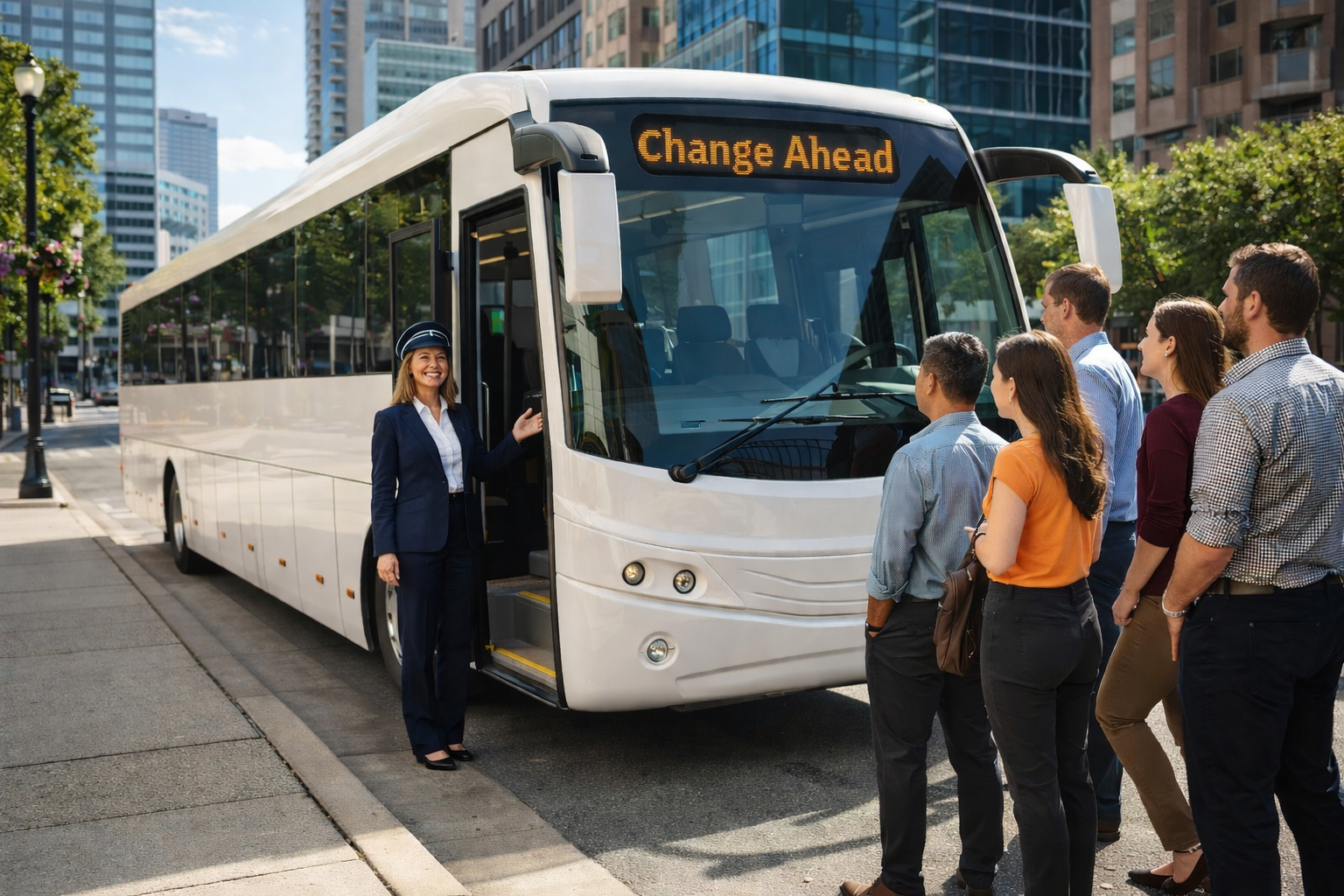
Every meaningful change feels a bit like going on a bus ride, and you are the driver. You know the destination, you have the route planned, and the bus is ready with the engine running. Yet people linger on the sidewalk with arms crossed and bags half packed, quietly deciding whether they trust this ride enough to step on board.
This is where many change efforts stall. Not because the destination is wrong, but because leaders confuse driving the bus with getting people to ride it. Change leadership and change management are not the same thing, but they are inseparable. As Peter Drucker famously said, “Management is doing things right; leadership is doing the right things.”
“Management is doing things right; leadership is doing the right things.” – Peter Druker
A Familiar Business Example: Changing Safety Culture
Consider an organization that has invested heavily in safety. There are binders on every shelf, procedures for every task, and rules posted on walls and bulletin boards. Compliance is tracked, and audits are passed. On paper, the organization is safe. Yet incidents still happen. Near misses go unreported. People follow the rules when supervisors are watching and take shortcuts when they are not.
Eventually, leadership realizes something needs to change. They do not want safety to be something people comply with; they want safety to be something people genuinely care about. This is not a policy update. It is a cultural shift. And cultural shifts are bus journeys.
The Driver and the Destination
Every change journey needs a driver. The change leader is the person in the seat behind the wheel, responsible for setting direction, watching the road, managing speed, and making sure the bus actually leaves the curb. Without leadership, the bus never moves. It idles indefinitely while the organization debates, delays, and rationalizes staying exactly where it is.
“Leadership defines what the future should look like, aligns people with that vision, and inspires them to make it happen despite the obstacles.” - John P. Kotter
John P. Kotter captured this distinction well when he said, “Leadership defines what the future should look like, aligns people with that vision, and inspires them to make it happen despite the obstacles.” This is where Kotter’s 8-Step Change Model becomes invaluable. It provides leaders with a structured roadmap for guiding the organization through change, not as a single announcement, but as a deliberate journey that includes creating urgency, building a guiding coalition, forming and communicating a clear vision, empowering action, generating short-term wins, sustaining momentum, and ultimately anchoring the change in culture.
Kotter 8-Step Change Leadership Model:
Create Urgency
Build a Guiding Coalition
Form a Strategic Vision
Communicate the Vision
Empower Action
Generate Short-Term Wins
Sustain Acceleration
Anchors Change in Culture
If you are a leader who wants safety to change in your organization, you must step into the driver’s seat and clearly announce the destination: We are moving from a rules-based safety system to a values-based safety culture, where every person arrives at work each day intending to protect themselves and their workmates so everyone goes home safe.
That destination sounds noble, but it is also abstract, uncomfortable, and threatening to some. Strong change leaders recognize this and do not start with slogans. They start with urgency. They explain why compliance alone is not enough. They share the stories behind incidents, not just the statistics, and they connect safety failures to real human consequences, reputational risk, and moral responsibility.
They also build a guiding coalition of supervisors, respected operators, safety professionals, and informal influencers. These people become trusted change agents, not simply individuals with job titles. Together, they define what “good” looks like when safety becomes a value: people stop work without fear, near misses are shared as learning rather than as blame, supervisors coach rather than police, and leadership actions consistently match safety words.
As the bus begins to move, the leader removes barriers, empowers action, and deliberately plans early stops that show progress. These short-term wins matter because they build confidence that the journey is real and that the destination is achievable. Over time, momentum builds, acceleration continues, and eventually the route becomes embedded into how the organization operates. At that point, it is no longer viewed as a change but simply as the way things are done. This is change leadership.
The People Waiting at the Bus Stop
Leadership alone, however, does not fill the seats. At the curb stand the riders, individuals with their own experiences, fears, motivations, and questions. Some are eager to board, others hesitate, and a few quietly hope the bus leaves without them so they can avoid making a decision altogether. At this stage, many leaders grow frustrated. The plan is solid, and the case for change is clear, so why will people not get on the bus?
“People don’t resist change. They resist being changed!” – Peter Senge
The answer is simple. Organizations do not change; people do. This is where change management and the ADKAR model become essential. ADKAR describes the individual journey through change as five building blocks: awareness, desire, knowledge, ability, and reinforcement. As Peter Senge observed, “People don’t resist change. They resist being changed.”
ADKAR Change Management Model:
A — Awareness
D — Desire
K — Knowledge
A — Ability
R — Reinforcement
When it comes to safety, people do not adopt a new culture because leadership declares one. They adopt it because, one by one, it begins to make sense to them. First, they need awareness. Why are we changing? What is broken in the current system? Why does this matter now? Next comes desire, which is where safety becomes personal. Leaders connect the change to what people genuinely care about, such as going home uninjured, protecting friends on the crew, pride in craftsmanship, and looking after family by staying healthy.
Then comes knowledge. People need to understand what a values-based safety culture looks like in everyday work. What do I say when I see something unsafe? What authority do I really have to stop work? How do I raise concerns without being labelled difficult? Knowledge must then turn into ability. Leaders create space to practice. Supervisors coach instead of disciplining. Mistakes become learning moments, and confidence grows as people experience that speaking up is supported rather than punished.
Finally, reinforcement makes the change stick. Leaders recognize safe decisions even when they slow down the job. Performance systems align with safety values, and stories of positive intervention are shared and celebrated. That is how people get on the bus and choose to stay on it.
Corporate Culture: Who Is on the Bus Matters
At some point, many leaders reach a difficult realization. Some people are fully committed to the new safety culture. Some are struggling but genuinely trying. Others, despite training, communication, and support, simply do not believe in it. This is where the question of who is on the bus becomes critical.
Jim Collins’ bus analogy from Good to Great is especially relevant here. Collins argues that great organizations do not start by deciding where to go; they start by deciding who gets on the bus. The same applies to safety culture. Leaders must ensure they have the right people before locking in long-term direction. Technical skill alone is not enough; people must be in roles where their attitudes and influence support a culture of safety. Keeping individuals who undermine safety through shortcuts, cynicism, or a poor work ethic will erode credibility faster than any policy gap. With the right people, leaders spend less time enforcing rules and more time reinforcing values.
The uncomfortable truth is this. If the wrong people are on the safety bus, it does not matter how compelling the destination is. The culture will not change. But when the right people are in the right seats, the organization becomes adaptable. It can handle new risks, new operations, and new challenges without constantly rewriting rules. As Edgar Schein reminds us, “Culture is the deepest level of assumptions and beliefs shared by members of an organization.”
“Culture is the deepest level of assumptions and beliefs shared by members of an organization.” – Edgar Schein
Change is not an event. Change is a journey, and successful change requires three things working together.
Change Leadership to set the direction and momentum
Change Management to help individuals move through uncertainty
People Decisions to ensure the bus is filled with those who truly belong on the journey
Ron Bettin, MBA, PMP, CMC, is a Canadian executive and public speaker with more than 25 years of leadership and entrepreneurial experience. He co-founded several companies and provides management consulting through Adduco Inc. to organizations of all sizes. Ron understands the importance of building value and enabling success through leading change and managing complexity. He is a graduate of the Southern Alberta Institute of Technology and holds an MBA from Queen’s School of Business.